


TESTING OF LIQUID OFF-TAKE VALVES
- Visual inspection
- Performance test @ differential pressures
- Filling trail test @ Different differential pressures
- Excess flow device & Residual leak test.
- Internal & External tightness test @ 0.1 kgf/cm² & 17 kgf/cm²
- Performance test of Safety relief valve.
- Flow capacity test of Safety relief valve.
- Chemical composition and valve dimensions analysis of valve body.
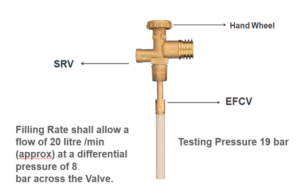
- Liquid Off take Valve to be fitting to LPG Gas Cylinders/tanks should be manufactured as per BIS 16484 (Latest) / ISO 15995 (Latest).
- In an LPG Cylinder, LPG exists in dual phase under equilibrium i.e. Vapor phase and Liquid phase. Normally, during usage, LPG is withdrawn in the vapor phase through the Self Closing (SC) Valve fitted on LPG Cylinder,
- This LOT valve is made of brass and is designed as per IS-8737. The Liquid Off Take Valve (LOT) is to facilitate the withdrawal of LPG from cylinder (up to water capacity of 111 litres) in liquid phase.
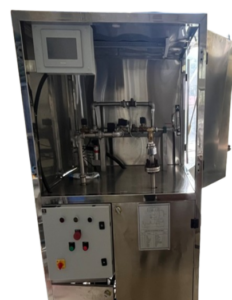
- AS PER IS 16484: 2017
- In this test bench
- Performance Test
- Filling trial test at differential pressures
- Excess flow device test (EFCV)
- Residual leak test
| Test Description | Significance |
| Performance Test | Withdrawal of the valve is checked at Test pressures of 8, 6, 4 & 1.5 kgf/cm² |
| Filling trial test at differential pressures of 7, 3.5, 1.7 & 0.7 kgf/cm² | |
| Excess flow device test (EFCV) | Valve shall operate at flow rate of not more than 10% above nor less than 20% below the rated closing flow capacity specified (LPM) and it shall close automatically at pressure across valve of not more than 1.4 kgf/cm² |
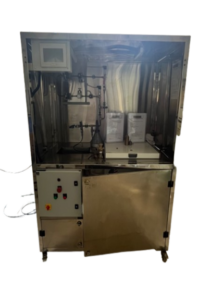
- AS PER IS 16484: 2017
- Performance Test of Safety Relief Valve
- Resealing pressure
- Internal Tightness Test
- External tightness test
- External and Internal tightness at Hight temperature (65°C)
- 6. External and Internal tightness at Low temperature (-20°)
| Test Description | Significance |
| Performance Test of Safety Relief Valve | Start to discharge pressure at which the first bubble appears through a water seal of not over 100 mm on the outlet of the pressure relief valve shall be within ±5% of nominal set pressure or as per customer requirement |
| Resealing pressure | The Pressure at which the leakage ceases through the water seal shall not be less than 90 % of the initially observed start to discharge pressure or as per customer requirement |
| Test Description | Significance |
| Internal Tightness Test | Test Pressure: 0.1 kgf/cm2 |
| Test Pressure: 17.0 kgf/cm2 | |
| External tightness test | Test Pressure: 0.1 kgf/cm2 |
| Test Pressure: 17.0 kgf/cm2 | |
| External and Internal tightness at Hight temperature (65°C) | Test Pressure: 0.1 kgf/cm2 |
| Test Pressure: 17.0 kgf/cm2 | |
| External and Internal tightness at Low temperature (-20°) | Test Pressure: 0.1 kgf/cm2 |
| Test Pressure: 17.0 kgf/cm2 |
VALVE INLET THREADS
| Description | Requirement |
| Standard Hand Tight, L1 | 3.0 ± 1.81 |
| Length of Full Extended Thread, L8 | L1 + 1.81 / -0 |
| Truncation | L1 + 2.65 / -0 |
SPARK EMISSION SPECTROMETER CHEMICAL COMPOSITION OF VALVE
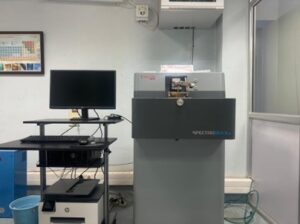
PURPOSE :
To determine the elemental composition of Brass for SC Valve as per IS 16484: 2017
|
ELEMENT |
IS 8737 |
|
COPPER |
56.5 – 60.0 % |
|
LEAD |
1 – 2 % |
|
MANGANESE |
0.50% Min |
|
IRON |
0.30% Max |
|
ZINC |
Remainder |
- ADDITIONAL TESTS FACILITIES AS PER IS 16484-2017
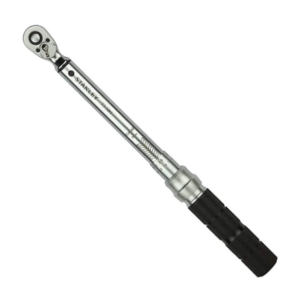
Requirement:
There shall be no sign of shearing/cracking
Torque Test
Threaded valve stem shall be tightened to a torque of 220 N-m.
